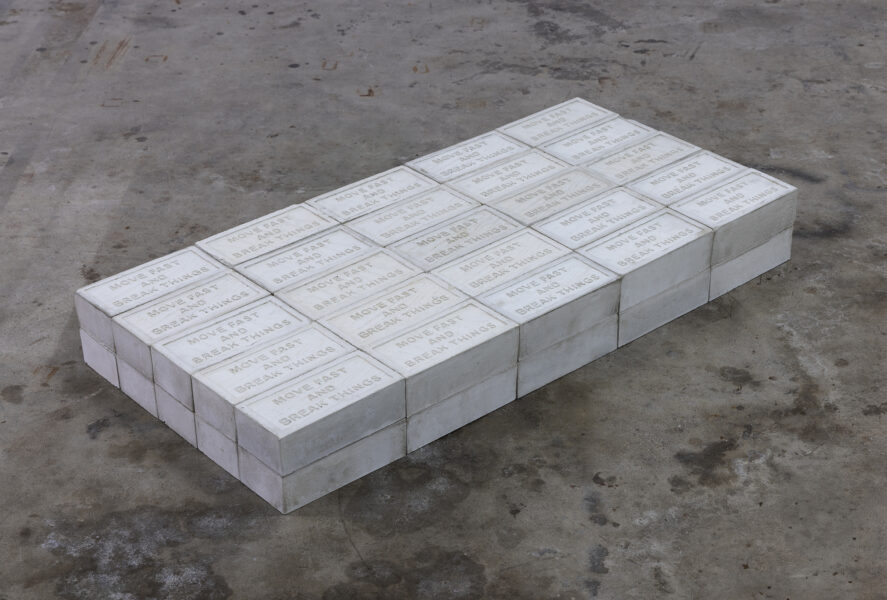
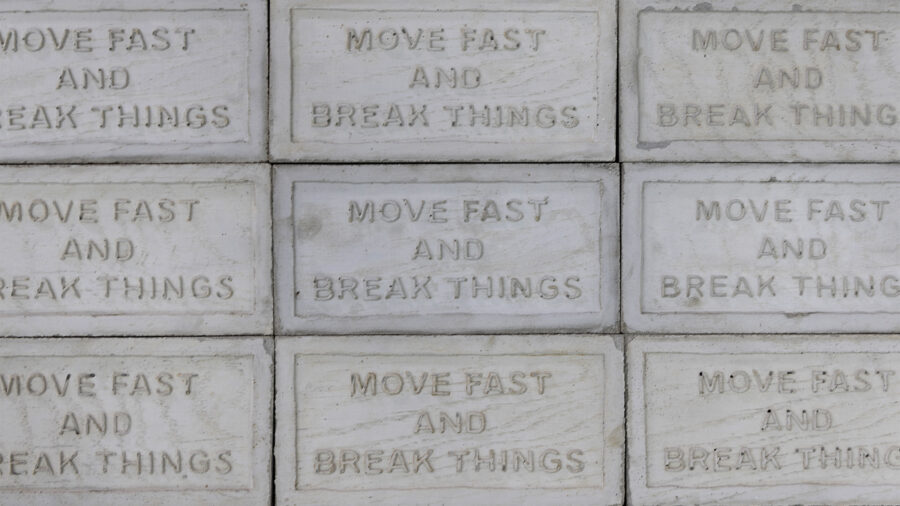
Inequivalent I echoes Carl Andre’s Equivalent VIII to question who is permitted to “break things” in the United States and who is punished for doing so. Fifty cast concrete bricks arranged in a minimalist grid are each cast with the phrase “Move Fast and Break Things,” a slogan synonymous with technological disruption and the belief that progress justifies collateral damage.
The number of bricks corresponds to modern anti-protest laws passed in the United States, using legislation as a measure of the growing tension between capitalism and civic dissent. While disruption enacted by wealthy individuals, corporations, and institutions is often framed as innovation, reform, or efficiency, acts of collective resistance are increasingly criminalized.
Drawing on the formal language of Minimalism, Inequivalent I examines hypocrisy, unequal consequences, and the rhetoric that sanitizes harm.